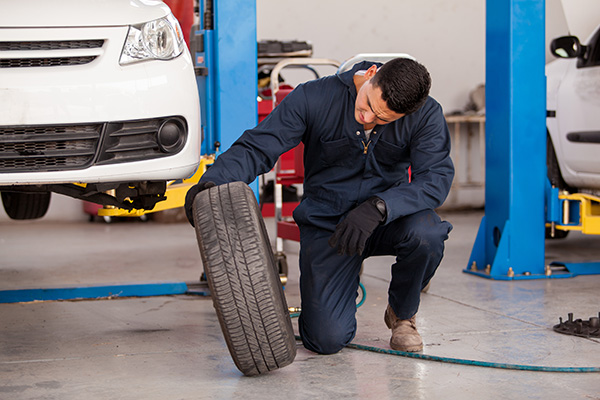
Few things are more annoying than paying to have your tires balanced and still feeling vibration on the drive home. The steering wheel shakes at highway speed, the seat buzzes, or the whole car feels like it has a nervous hum that was supposed to be gone. It is easy to think the balancing job did not work.
Sometimes that is true. A wheel weight can be placed incorrectly, a tire can shift on the rim, or the balance may need to be checked again. But tire balance is only one cause of vibration. If the tires are balanced correctly and the shake persists, the problem may be in the tire, wheel, brakes, suspension, steering, or drivetrain.
A Balanced Tire Can Still Have Other Problems
Balancing corrects uneven weight around the tire and wheel assembly. At speed, even a small heavy spot can create a shake. A balance machine can measure that weight difference and show where weights should be added.
But balance does not make a damaged tire round again. It does not straighten a bent wheel. It does not fix worn suspension parts or brake rotors. A tire can be perfectly balanced on the machine and still vibrate on the road if the tire or wheel shape is wrong.
That is why the question is not always, “Were the tires balanced?” The better question is, “What else could still be making the vehicle shake?”
The Tire Itself May Be Out Of Shape
Tires are supposed to roll evenly, but they do not always wear or age that way. A tire can develop a shifted belt, a flat spot, a separated internal layer, cupping, or an uneven tread pattern. From the outside, it may not look terrible at first glance.
A tire with an internal belt problem can feel like a vibration, wobble, or thumping that gets worse with speed. Cupped tires can make a rhythmic noise and vibration that balance weights will not remove. A flat-spotted tire may feel worse after the car has been parked and then improve slightly as the tire warms up.
Tread wear tells a useful story. If one tire has patches, scallops, waves, or a strange high-low pattern, the vibration may be caused by how the tire contacts the road, not by wheel balance.
A Bent Wheel Can Hide Behind A Good Balance
A wheel does not have to look badly damaged to cause a vibration. A pothole, curb hit, or road debris can bend the inner lip, making it harder to see. The wheel may still hold air and balance on the machine, but it may not roll straight.
Bent wheels often create vibration at certain speeds. The shake may feel worse through the steering wheel if the bent wheel is on the front, or more through the seat and floor if it is on the rear. Some bent wheels also cause slow air leaks when the bead area no longer seals correctly.
Checking wheel runout can show whether the wheel is moving side to side or up and down as it spins. That test catches problems a normal balance may not explain.
Worn Suspension Or Steering Parts Can Shake The Car
Tires and wheels need firm support. If tie rods, ball joints, control arm bushings, struts, shocks, or wheel bearings are worn, the tire may not stay controlled on the road. That movement can feel like a tire vibration even after balancing.
A loose front-end part can also let a small tire issue feel much worse. The tire may start the vibration, but a worn suspension allows it to travel through the steering wheel and into the cabin. In other cases, the tire is not the problem at all. The shake is coming from play in the steering or suspension.
Vibration with clunking, wandering, uneven tire wear, or a loose steering feel should point the inspection beyond the tires.
Brake Vibration Can Feel Like Tire Vibration
Not every shake happens because of the tires. If the vibration shows up mostly when braking, the brake system may be involved. Rotor thickness variation, uneven pad transfer, sticking calipers, or worn brake hardware can create a pulsing feel.
A brake-related shake often feels strongest through the steering wheel or brake pedal. It may be light during normal driving and then appear when slowing from highway speeds. Drivers sometimes describe it as a tire shake because the whole front of the vehicle reacts.
The timing is the clue. A vibration while cruising at 60 mph points one direction. A vibration only while braking from 60 mph points another.
Details That Help Narrow It Down
The way the vibration behaves can save time during testing. Pay attention to the pattern before bringing the vehicle in.
- The steering wheel shakes mostly at highway speed, which often points to a front tire imbalance, a bent front wheel, or looseness in the front steering parts.
- The seat or floor vibrates more than the steering wheel, which can point toward rear tires, rear wheels, driveline concerns, or vibration traveling through the body.
- The shake starts only when braking, which makes brake rotors, calipers, pads, and related hardware more likely than simple tire balance.
- The vibration changed after a tire rotation, which may mean one tire has a wear or shape problem, and the symptom moved with the tire.
- The car also pulls, wanders, or wears tires unevenly, which usually means alignment, suspension wear, tire condition, or steering parts need to be checked together.
These details do not replace testing, but they help avoid chasing the wrong system first.
Why A Road Test And Careful Check Help
A vibration complaint should usually include a road test, tire and wheel check, balance verification, tread inspection, wheel runout check when needed, and a look at steering and suspension parts. If braking changes the vibration, the brake system should be checked too.
Regular maintenance visits are a good time to catch uneven tire wear, loose parts, bent wheels, and early brake concerns before they turn into a stronger shake. A car that still vibrates after balancing is not being difficult for no reason. It usually tells you that the balance was only one piece of the puzzle.
Get Tire Vibration Diagnostics In Garden Grove, CA, With Morrison Tire Inc.
If your car still vibrates after the tires have been balanced, Morrison Tire Inc. in Garden Grove, CA, can check the tires, wheels, brakes, steering, suspension, and related parts to find what is really causing the shake.
For tire vibration diagnostics and repair, contact us to schedule an appointment.